Pull-ups vs. lat pulldown — which is better?

According to EMG studies, pull-ups and the lat pulldown activate the latissimus dorsi to a comparable degree. Pull-ups place greater demands on the core and stabilizers. The lat pulldown is the better fit for beginners and high-rep work — ideally, you combine both.
The two exercises compared
Pull-ups are a bodyweight exercise in which you pull your body up to a bar. The lat pulldown is done on a cable machine, pulling a bar down to your chest. Both exercises primarily train the latissimus dorsi, with the biceps, rear delts, and traps working as secondary movers.
Evidence on muscle activation
| Exercise | EMG activation of the lats |
|---|---|
| Pull-ups | Very high |
| Lat pulldown to the chest | High (comparable) |
| Behind-the-neck pulldown | Lower, biomechanically less favorable |
What the studies show
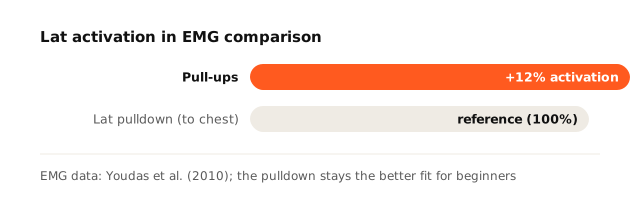
Lusk et al. (2009), writing in the Journal of Strength and Conditioning Research (JSCR), compared EMG activity during the lat pulldown across different grip styles. A wide overhand grip produced the highest lat activation — comparable to pull-ups. Youdas et al. (2010) found that pull-ups activate the lats roughly 12 percent more than the pulldown to the chest — alongside markedly higher core muscle activity.
Practical differences
Pull-ups require a minimum level of strength relative to body weight. Many beginners — especially heavier lifters — can't complete a single clean rep at first. The lat pulldown solves this with precise load adjustment via the weight stack, making it the better choice for beginners. Advanced lifters can progress pull-ups with added weight and switch to the lat pulldown for high-rep hypertrophy work.
Combining both exercises
The NSCA recommends building both exercises into your back-training routine:
- Pull-ups as the main exercise for maximal strength and functional back development
- Lat pulldown as an accessory exercise for higher-volume rep work (8–15 reps)
- Assisted pull-ups or negative pull-ups for beginners building up strength
- Grip variations (overhand, underhand, neutral) to shift emphasis across the back muscles
Log your workouts in 5 seconds with GymLog AI
GymLog AI automatically recognizes weighted or assisted pull-ups as well as lat pulldown variations, and shows your combined back volume.
Download on the App StoreSources
- Lusk, S. J., et al. (2009). Grip width and forearm orientation effects on muscle activity during the lat pull-down. JSCR. PubMed
- Youdas, J. W., et al. (2010). Surface electromyographic activation patterns and elbow joint motion during a pull-up, chin-up, or perfect-pullup rotational exercise. JSCR. PubMed
- Signorile, J. F., et al. (2002). A comparative electromyographical investigation of muscle utilization patterns using various hand positions during the lat pull-down. JSCR. PubMed
- NSCA. Essentials of Strength Training and Conditioning. nsca.com