How many calories are in rice?
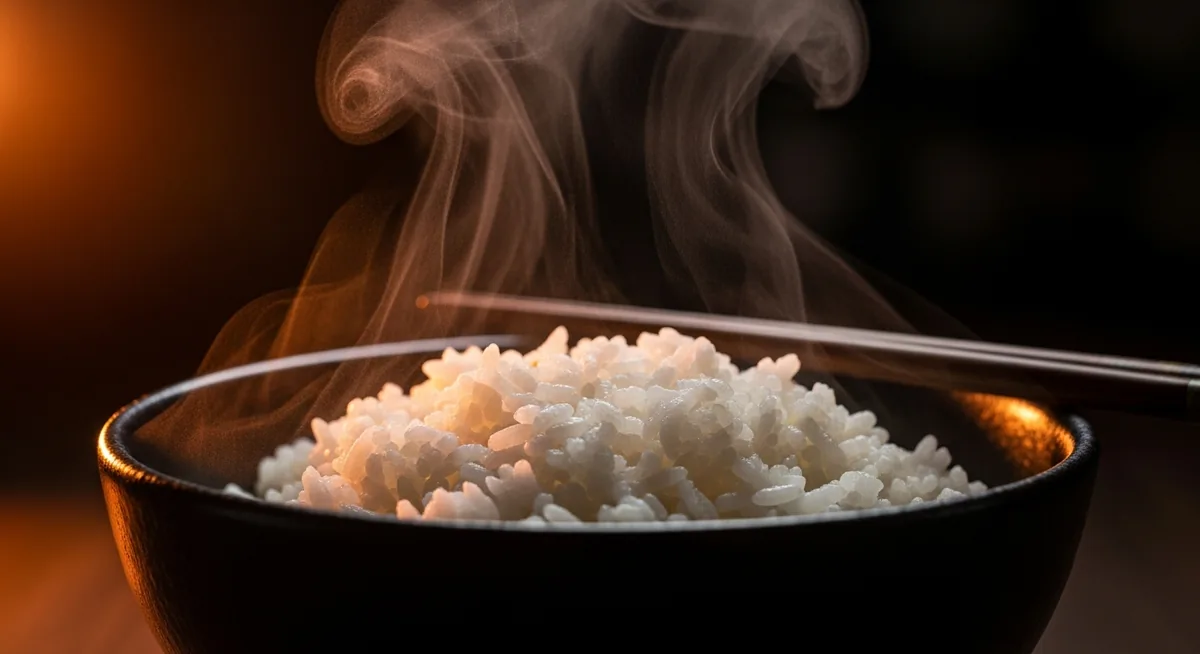
According to USDA FoodData Central, 100 grams (3.5 oz) of raw white rice contain around 360 calories — but only about 130 calories once cooked. The difference comes from the water rice absorbs during cooking; the dry matter stays exactly the same.
Why raw and cooked rice look so different on paper
A rice grain is more than 80 percent starch. During cooking, that starch swells and soaks up roughly 2.5 times its dry weight in water. A single grain ends up weighing about three times as much as it did raw — without a single extra calorie being added. For your calorie count, what matters is whether the rice was weighed raw or cooked.
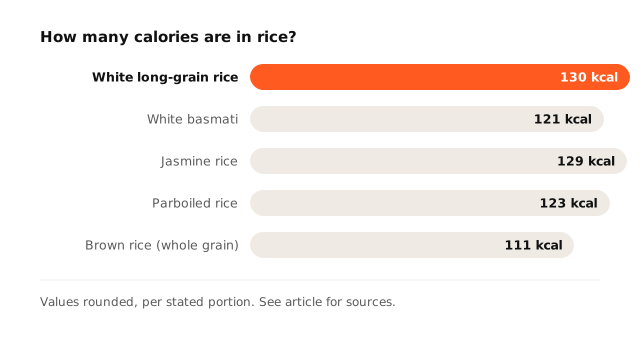
Calories by rice variety
| Variety (100 g cooked) | Calories |
|---|---|
| White long-grain rice | 130 kcal |
| White basmati | 121 kcal |
| Jasmine rice | 129 kcal |
| Parboiled rice | 123 kcal |
| Brown rice (whole grain) | 111 kcal |
Real-world portion sizes
The German Nutrition Society (DGE) recommends 60 to 80 grams (about 2–2.8 oz) of dry rice per main meal, which works out to roughly 180 to 240 grams once cooked. A portion that size delivers between 235 and 290 calories, depending on the variety. Restaurant servings at Asian restaurants often run to 300 to 400 grams cooked — that is 390 to 520 calories for the rice alone, before any sauce or sides.
Rice and muscle growth
Rice is one of the easiest carbohydrate sources to digest, which is exactly why athletes love it. In its position stand on carbohydrate intake for strength training, the ISSN explicitly lists rice as a suitable base for pre- and post-workout meals. A 200-gram (7 oz) serving of cooked rice provides around 55 grams of carbohydrate — enough to restock muscle glycogen stores after a workout.
Resistant starch from cooling
A study by Sonia et al. (2015) documented that when cooked rice cools, part of its starch converts into resistant starch, which is not fully digested in the small intestine. In the lab, this cuts the usable energy by roughly 10 to 15 percent — in practice, though, the effect is moderate. Reheating does not fully convert the resistant starch back into digestible starch.
Start tracking calories with GymLog AI
GymLog AI automatically tells raw rice from cooked and converts your portion into your daily budget in seconds.
Download on the App StoreSources
- USDA FoodData Central. Rice, white, long-grain, regular, cooked. fdc.nal.usda.gov
- Max Rubner Institute. Bundeslebensmittelschlüssel (BLS), version 3.02 — Germany’s national food composition database. blsdb.de
- German Nutrition Society (DGE). Wholesome eating and drinking — recommended food amounts. dge.de
- Atkinson, F. S., et al. (2021). International Tables of Glycemic Index and Glycemic Load Values 2021. Am J Clin Nutr. PubMed
- Sonia, S., et al. (2015). Effect of cooling of cooked white rice on resistant starch content and glycemic response. Asia Pac J Clin Nutr. PubMed
- Kerksick, C. M., et al. (2018). ISSN exercise & sports nutrition review update: research & recommendations. JISSN, 15:38. PubMed