Upper/lower split: how good is it?

The upper/lower split divides training into upper-body and lower-body days, typically across 4 sessions per week. It strikes a solid balance between training frequency and recovery — a great fit for early intermediates.
The basic structure
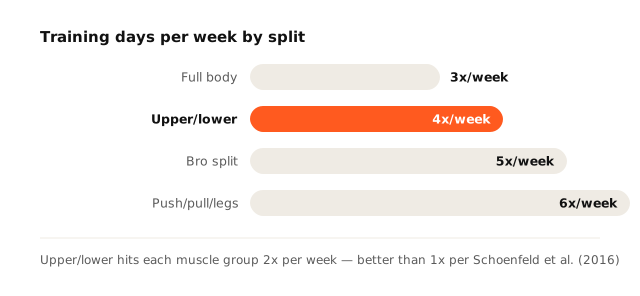
The classic upper/lower split consists of four weekly sessions: two upper-body and two lower-body workouts. Every muscle group gets trained twice per week — right in the range that training frequency research identifies as optimal for hypertrophy.
- Monday: Upper A (bench press, rows, overhead press, pull-ups, triceps, biceps)
- Tuesday: Lower A (squats, Romanian deadlifts, leg press, calf raises)
- Thursday: Upper B (incline bench press, lat pulldowns, lateral raises, single-arm rows)
- Friday: Lower B (deadlifts, lunges, leg curls, hip thrusts)
The evidence on training frequency
A meta-analysis by Schoenfeld et al. (2016) in Sports Medicine reviewed 10 studies on how training frequency affects hypertrophy. The finding: at equal total weekly volume, training a muscle group twice per week produces greater gains than once. With four sessions, the upper/lower split hits this sweet spot perfectly.
| Split type | Best suited for |
|---|---|
| Full body (3x/week) | Beginners |
| Upper/lower (4x/week) | Early intermediates |
| Push/pull/legs (6x/week) | Advanced lifters with plenty of time |
| Bro split (5x/week, 1 muscle/day) | Not evidence-based |
How it compares to push/pull/legs
With six training days, PPL allows more total work and smaller muscle-group clusters per session. Upper/lower is the more efficient choice when only four training days are available. According to a study by the meta-analysis by Schoenfeld, Grgic & Krieger (2019), both systems are equally effective for hypertrophy once volume is matched — your schedule makes the call.
Who it suits best
Per NSCA guidance, the upper/lower split works well for:
- Lifters with 4 fixed training days per week
- Beginners who, after 6 to 12 months of full-body training, want to push volume higher
- Strength athletes targeting both upper and lower body equally
- Anyone who wants to keep upper- and lower-body sessions free of carry-over fatigue
Log your workouts in 5 seconds with GymLog AI
GymLog AI calculates your weekly volume per muscle group automatically — whether you run upper/lower, PPL, or full body.
Download on the App StoreSources
- Schoenfeld, B. J., et al. (2016). Effects of Resistance Training Frequency on Measures of Muscle Hypertrophy: A Systematic Review and Meta-Analysis. Sports Medicine. PubMed
- Schoenfeld, B. J., Grgic, J. & Krieger, J. (2019). How Many Times per Week Should a Muscle Be Trained to Maximize Muscle Hypertrophy? A Systematic Review and Meta-Analysis. Journal of Sports Sciences, 37(11), 1286–1295. PubMed
- Grgic, J., et al. (2018). Effects of Resistance Training Frequency on Gains in Muscular Strength: A Meta-Analysis. Sports Medicine. PubMed
- NSCA. Essentials of Strength Training and Conditioning. nsca.com