How many calories are in an apple?
A medium apple weighing 180 grams (6.3 oz) delivers around 94 calories, according to USDA FoodData Central. Per 100 grams (3.5 oz) of apple flesh, that works out to 52 calories — one of the lowest values among everyday fruits.
Your own meal? Snap a photo – the AI estimates calories and macros in seconds. 3 free scans a day, no sign-up.
Keep scanning in the GymLog AI app – with daily targets and history.
Get the app for free →Nutrition facts and composition
An apple is roughly 85 percent water, which explains its low energy content. Per the German BLS food database, 100 grams of apple flesh provide 13.8 grams of carbohydrate — including 10.4 grams of sugar, mostly fructose and glucose — plus 2.4 grams of fiber. Protein and fat content are negligible.
Calories by apple size
| Size (with core) | Calories |
|---|---|
| Small (approx. 130 g / 4.6 oz) | 68 kcal |
| Medium (approx. 180 g / 6.3 oz) | 94 kcal |
| Large (approx. 220 g / 7.8 oz) | 114 kcal |
Differences between varieties
Calorie density varies only slightly from one apple variety to the next. Granny Smith is the lowest-calorie common variety at around 48 calories per 100 grams, thanks to a lower sugar content and higher acidity. Sweeter varieties like Pink Lady or Fuji sit at the upper end with 55 to 58 calories per 100 grams. The difference per apple is usually less than 10 calories — not enough to matter for your calorie balance.
Apples as a snack
With its high water content and moderate fiber, the apple counts as a filling snack with comparatively low calorie density, according to data from Germany's Federal Center for Nutrition (BZfE). A study by Flood-Obbagy and Rolls (2009) found that eating a whole apple before a meal reduced calorie intake at that meal by an average of 15 percent. The effect disappeared with pulp-free apple juice.
Apple juice and applesauce compared
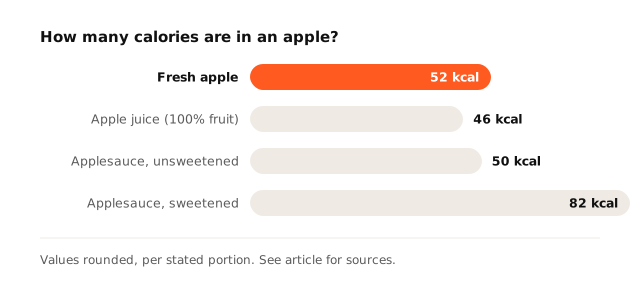
| Product (100 ml/g) | Calories |
|---|---|
| Fresh apple | 52 kcal |
| Apple juice (100% fruit) | 46 kcal |
| Applesauce, unsweetened | 50 kcal |
| Applesauce, sweetened | 82 kcal |
Start tracking calories with GymLog AI
GymLog AI recognizes fruit and snacks from a photo and logs that apple against your daily budget in seconds.
Download on the App StoreGet it on Google PlaySources
- USDA FoodData Central. Apples, raw, with skin. fdc.nal.usda.gov
- Max Rubner Institute. Bundeslebensmittelschlüssel (BLS), version 3.02 — Germany’s national food composition database. blsdb.de
- German Federal Center for Nutrition (BZfE). Apples — product guide. bzfe.de
- Flood-Obbagy, J. E., Rolls, B. J. (2009). The effect of fruit in different forms on energy intake and satiety at a meal. Appetite. PubMed